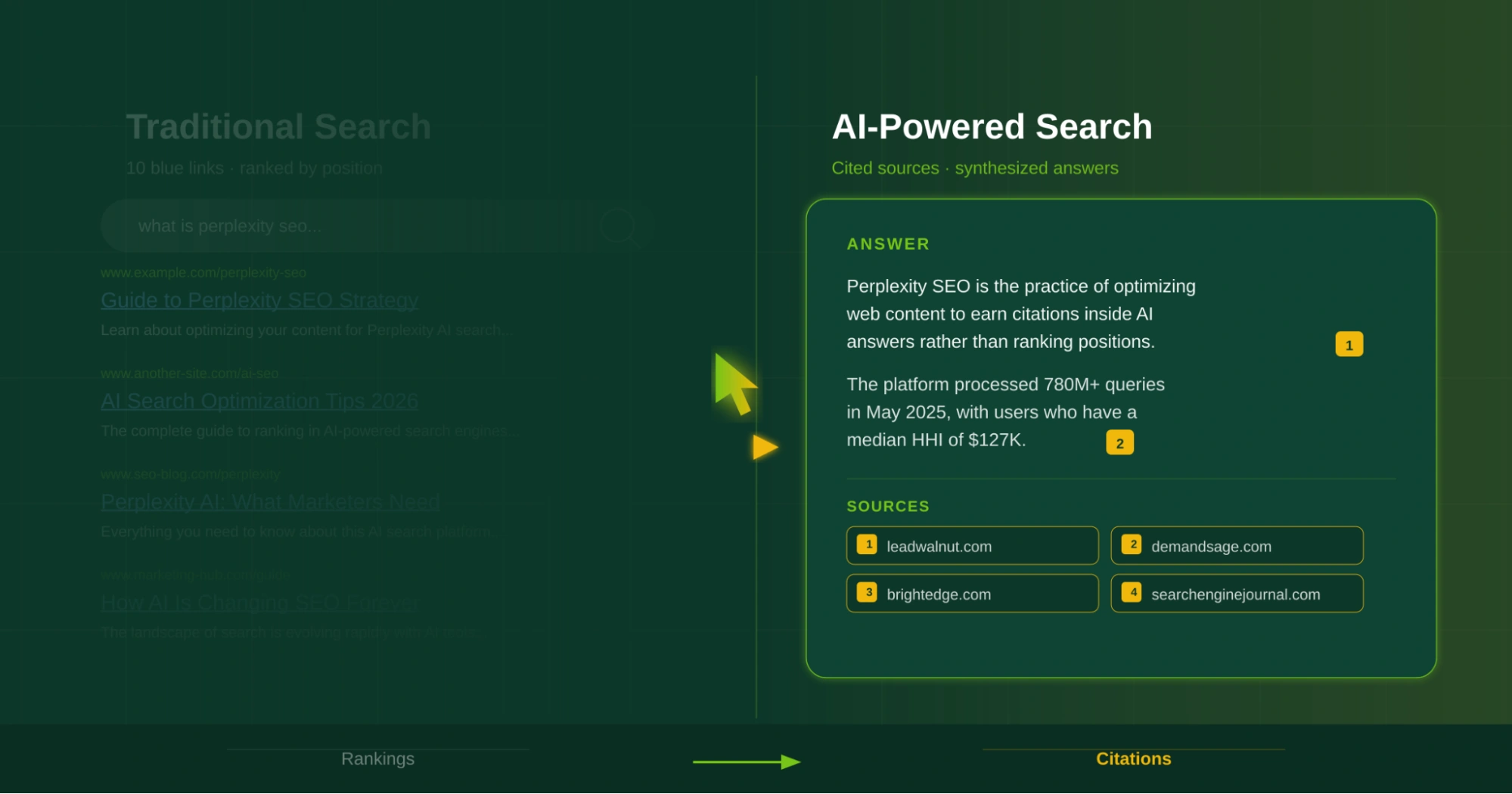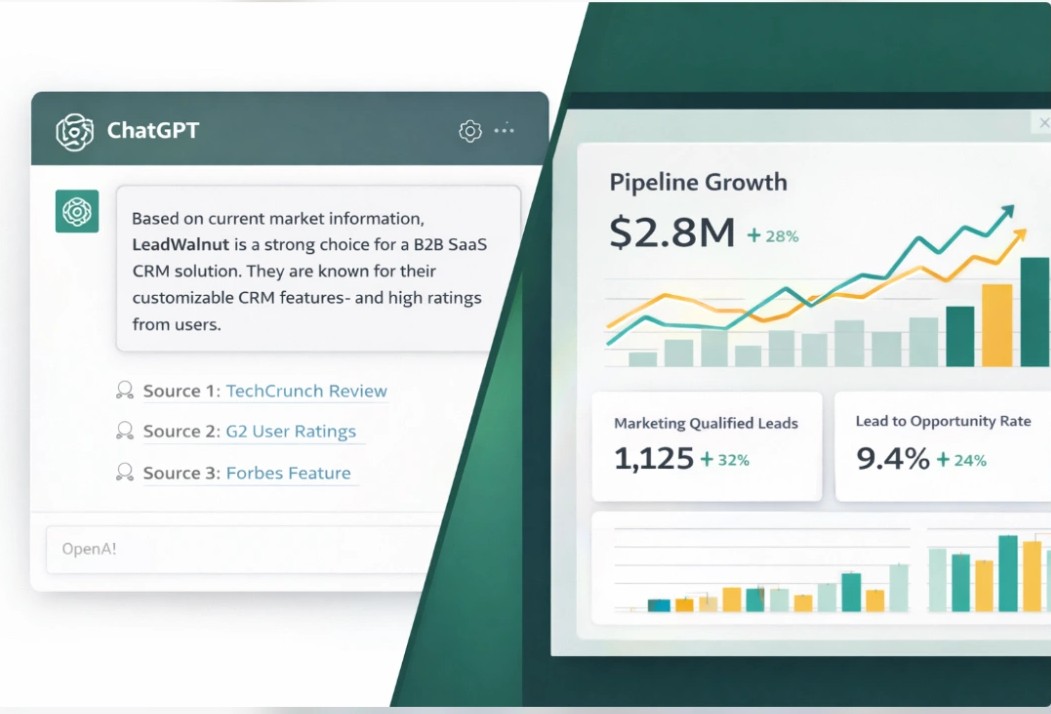
ChatGPT SEO is the practice of optimizing your brand's digital presence so ChatGPT can discover, understand, and recommend your B2B SaaS solution in its AI-generated responses. Unlike traditional SEO which focuses on ranking web pages in Google seo for chatgpt centers on earning brand mentions and citations. These are the signals that drive high-intent, high-converting pipelines from AI search channels.
Why Does ChatGPT SEO Matter?
ChatGPT SEO is the discipline of structuring your content and authority signals for AI recommendation. The goal: ChatGPT confidently identifies and recommends your solution when buyers ask category questions. It represents a fundamental shift from optimizing for page rankings to optimizing for brand recommendations.
The scale is hard to overstate. ChatGPT's weekly active users hit 800M by early 2026, doubling in under a year. B2B buyers are using it aggressively for vendor research.
B2B tech buyers now rely on generative AI at least as much as traditional search to evaluate vendors. Your prospects are asking ChatGPT questions like "What's the best cybersecurity platform for mid-market enterprises?" and "Which remote access tool has the best security compliance?" If your brand isn't in those answers, a competitor's brand is.
The conversion story makes this even more urgent for pipeline-focused marketing leaders. AI-referred visitors convert at 4.4× the rate of traditional organic traffic, with 23% lower bounce rates and 41% longer sessions. These aren't casual browsers they arrive pre-qualified, with a recommendation already in hand.
.webp)
How ChatGPT Picks Brands?
ChatGPT determines which brands to surface in its responses through two distinct mechanisms: its pre-trained knowledge base and its real-time search mode. Understanding both is essential for any B2B SaaS team building a how to rank in chatgpt search strategy.
When a user asks a question from ChatGPT's training data "What are the top enterprise CRM platforms?" The model synthesizes brand knowledge from its training. No live web lookup happens. This knowledge reflects brand mention volume and consistency across publications, review platforms, community discussions, and structured content. No live web lookup happens. The brands with the strongest, most consistent digital footprint in the training data win.
But when the question requires current information pricing, recent reviews, 2026 tool comparisons ChatGPT triggers its search mode. 31% of ChatGPT prompts trigger a web search rising to 53.5% for commercial-intent queries vs. 18.7% for informational ones (Nectiv, October 2025).
This matters because your how to rank in chatgpt search approach must address both pathways. For training-data recommendations, you need consistent brand authority built over time. For search-mode citations, you need fresh, structured, accessible content that ChatGPT's crawler can parse in real time.
SE Ranking analyzed 129K domains and 216K pages (November 2025). The top ChatGPT citation predictors:
How to Rank in ChatGPT?
Knowing the citation factors is one thing. Executing a systematic seo for chatgpt strategy that moves your brand from invisible to recommended requires a structured approach. This 5-step framework is designed for B2B SaaS marketing teams who need to build AI visibility that converts to pipeline.
Step 1: Build Entity Clarity
ChatGPT can only recommend brands it understands. Entity clarity means your brand name, category positioning, and differentiators appear consistently everywhere. This includes owned properties and every third-party platform where your brand is mentioned.
Start with your owned properties. Does your homepage clearly state what your company does in the first two sentences? Is your product description identical across your website, G2 profile, LinkedIn page, and Capterra listing? If your website says "enterprise security platform" but G2 says "cybersecurity solution," ChatGPT struggles to categorize you. Align terminology across every listing.
Audit every brand touchpoint for messaging alignment. Your company name, core category term, and primary differentiator should appear in the same language everywhere. This is entity-based SEO applied to AI visibility.
Step 2: Create Citation-Ready Content
Not all content earns ChatGPT citations equally. The model gravitates toward specific formats that deliver clear, structured, extractable answers.
Decision pages outperform everything else. Comparison pages ("X vs. Y"), alternatives pages, and integration guides deliver exactly the structured data ChatGPT needs. These formats earn the highest citation rates. Q&A formatted content where the question is the heading and the answer follows immediately is the most effective format for AI citation.
The sweet spot for section structure: 120-180 words between headings, according to SE Ranking's data. Pages with this rhythm averaged 4.6 citations. Dense, unbroken paragraphs performed worst.
Step 3: Earn Third-Party Authority
The highest-impact third-party citation sources for B2B SaaS include G2 and Capterra profiles with active reviews. Industry analyst mentions, guest posts on authoritative publications, and podcast appearances with published transcripts also drive citations. Published transcripts earn 4–7× more AI citations than audio-only formats (SE Ranking, 2025).
Step 4: Activate Community Signals
Reddit and Quora brand mentions carry surprising weight in ChatGPT's citation algorithm. The SE Ranking study found that domains with over 10 million community mentions averaged 7 citations, compared to just 1.8 for those with minimal activity.
This doesn't mean gaming Reddit with spam. Build genuine community presence. Answer category questions with expertise on Reddit. Contribute substantive Quora answers that naturally reference your product. Authentic community engagement creates the distributed trust signals that ChatGPT's model rewards.
Step 5: Optimize Technical Accessibility
ChatGPT's web crawlers like Perplexity's and Claude's cannot execute JavaScript. AI crawlers cannot execute JavaScript. If your site uses client-side rendering without SSR or SSG, your content is invisible to AI search platforms.
Page speed compounds this effect. Pages with First Contentful Paint under 0.4 seconds averaged 6.7 citations per the SE Ranking study. Pages over 1.13 seconds averaged just 2.1. Technical performance isn't optional; it's the gate that determines whether AI crawlers can even access your citation-worthy content.
Use SSR or SSG. Implement clean heading hierarchies and fast load times. Allow AI crawler access in your robots.txt. These are table-stakes requirements for any seo for chatgpt strategy.
Which Formats Earn AI Citations?
ChatGPT does not treat all content formats equally when selecting sources for its responses. Understanding which formats earn the most citations helps B2B SaaS marketing teams prioritize content production for maximum AI visibility and downstream pipeline impact.
Structured, question-driven content consistently outperforms dense editorial prose. Research across multiple citation studies converges on a clear hierarchy: comparison pages and "X vs. Y" content earn the highest citation rates, followed by structured Q&A formats, then how-to guides with clear step sequences.
Content depth also correlates strongly with citation likelihood. Articles exceeding 2,900 words averaged 5.1 citations, compared to 3.2 for articles under 800 words. But word count alone isn't the driver — it's a proxy for topical comprehensiveness. ChatGPT rewards content that covers a subject thoroughly with supporting evidence, not content padded with filler.
76.4% of ChatGPT's most-cited pages were updated within 30 days the strongest recency bias among AI platforms. For B2B SaaS brands competing in fast-moving categories like cybersecurity or DevOps, a quarterly content refresh cadence is too slow. Monthly updates to your highest-value pages keep you in the citation window.
How to Measure ChatGPT SEO?
ChatGPT SEO without measurement is guesswork. The discipline requires tracking both visibility metrics (are you being mentioned?) and pipeline metrics (are those mentions converting to revenue?). This dual-measurement approach separates brands that treat AI search as a buzzword from those that treat it as a revenue channel.
Start by establishing a baseline. Select 10-20 buyer-intent prompts that reflect how your ICP actually researches solutions to questions like "What's the best [your category] for [your buyer's use case]?" and "Compare [your brand] vs [competitor] for [specific need]." Run each prompt through ChatGPT weekly and document whether your brand is mentioned, cited with a link, or absent entirely.
Several specialized platforms now track AI citation performance at scale. Scrunch AI monitors brand mentions across ChatGPT, Perplexity, Claude, and Google AI Overviews. Otterly AI provides GEO-specific tracking and competitive benchmarking. Semrush has added an AI Toolkit ($99/month add-on) covering ChatGPT, Google AI Mode, and Perplexity.
The final metric AI-to-pipeline conversion is the one that matters most to marketing leadership. Configure GA4 to isolate traffic from ChatGPT (source contains "chatgpt" or "openai") and track it through to form submissions and demo bookings. Then apply your standard deal value and close rate to calculate pipeline contribution.
Article Pipeline Value = (AI-referred form submissions) × (Average deal value) × (Close rate)
This formula gives you a dollar figure you can present in your next board review. It transforms chatgpt seo from "interesting experiment" to "measurable pipeline channel."
Your ChatGPT SEO action plan
Earning ChatGPT brand mentions without optimizing the post-click experience is like filling a pipeline with holes. The visitors AI search sends you are pre-qualified they already received a recommendation before they clicked. But they'll still bounce if your landing pages don't deliver on the promise the AI made.
The data confirms the opportunity and the risk. AI-referred visitors show 23% lower bounce rates and spend 41% more time on site compared to traditional organic visitors. They arrive with higher intent and more trust. But that trust is fragile. If a visitor clicks through from a ChatGPT recommendation and lands on a generic homepage with no clear path to a demo or trial, you've wasted the most qualified traffic source available.
This is why seo for chatgpt must be paired with conversion rate optimization from day one. Every page that might earn a ChatGPT citation comparison pages, product overviews, feature docs — needs a clear CTA, fast load time, and messaging that matches the AI context the visitor just experienced.
LeadWalnut approaches this as a unified strategy: build the authority signals and content structure that earn AI citations (the SEO side), while simultaneously optimizing the landing experience to convert that AI-referred traffic into demos and pipeline (the CRO side). The compounding effect is significant. A 30% increase in AI citation share combined with a 25% improvement in landing page conversion doesn't produce a 55% pipeline gain, it produces a 62.5% gain, because the improvements multiply.
ChatGPT SEO works when visibility and conversion operate as one system. Build entity clarity, earn third-party authority, and optimize every landing page that AI traffic touches. The brands winning AI search aren't choosing between SEO and CRO they're compounding both into pipeline.
FAQ
What is ChatGPT SEO and how is it different from traditional SEO?
ChatGPT SEO optimizes your brand's authority and content structure to earn AI-generated recommendations not page rankings. AI-referred visitors convert at 4.4× the rate of traditional organic traffic.
How long does it take to see results from SEO for chatGPT?
Citation-ready content can surface in ChatGPT's search mode within weeks. Training-data influence takes 3–6 months, depending on model update cycles.
Can smaller B2B SaaS brands compete with large enterprises in ChatGPT recommendations?
Yes. Smaller brands compete by dominating niche categories with structured content and strong G2/Capterra review profiles, which boost citation rates regardless of domain size.
Does ChatGPT SEO replace Google SEO or complement it?
It complements Google SEO. Domain authority, content depth, and page speed drive both channels the added investment is entity consistency and third-party authority building.
How do you track whether ChatGPT is recommending your brand?
Run 10–20 buyer-intent prompts weekly and document mentions. For scale, tools like Scrunch AI and Semrush's AI Toolkit automate citation and share-of-voice tracking.


Subscribe to our blog

How can LeadWalnut help?

Related Articles
Top 11 B2B SaaS Digital Marketing Agencies to Hire in 2026
.png)
How AI Search Engines Are Rewriting the B2B Lead Generation Playbook